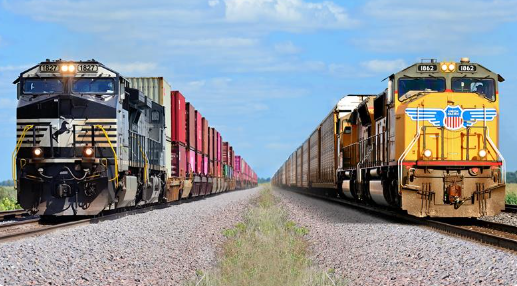
The proposed merger between Union Pacific (UP) and Norfolk Southern (NS) has passed shareholder approval and is undergoing regulatory review. If approved, it would create the first single-line rail network connecting the U.S. West Coast and East Coast under one carrier — a potential milestone for North American freight transportation.
This article explains how the combined network could improve transit times, reduce interchange delays, and increase routing flexibility across the continent.
1. Chicago Interchange Bottlenecks: A Long-standing Freight Constraint
For decades, the Chicago rail interchange has been the largest congestion point in U.S. freight movement.
Current State of Chicago Dwell
– East–west freight typically requires switching between UP and NS yards.
– Intermodal and carload traffic often experiences 24–48 hours of dwell.
– Rubber-tire drays between yards add cost and delay.
Potential Post-Merger Improvement
If UP and NS operate as a single railroad, trains could move straight through Chicago without handing off power or switching consist. Similar run-through operations on past mergers have produced double-digit improvements in transit time on lanes that no longer require interchange.
This would make rail more competitive on long-haul corridors such as:
– Los Angeles → New York/New Jersey
– Seattle/Tacoma → Pennsylvania and Mid-Atlantic
– Texas → Northeast distribution hubs
2. Multi-Gateway Flexibility Across the Mississippi River
A combined UP–NS network would connect through multiple major gateways:
– Chicago, IL
– St. Louis, MO
– Memphis, TN
– New Orleans, LA
Why Multi-Gateway Routing Matters
With unified control of these corridors, a merged system could route freight through alternate gateways during:
– Weather disruptions
– Congestion at a single interchange
– Seasonal surges
This creates network resilience through redundancy — a key factor in modern logistics.
3. Locomotive Fleet Integration and Maintenance Strategy
UP and NS locomotives differ significantly:UP operates large fleets of EMD SD70 series locomotives.NS maintains significant GE/Wabtec fleets, including the AC44C6M rebuild program.
Expected Post-Merger Maintenance Trends
Based on industry precedent:
– Jenks Shop (Little Rock, AR) may remain an EMD-focused heavy maintenance site.
– Juniata Shops (Altoona, PA) could continue as a GE/Wabtec rebuild and overhaul center.
Specialization could reduce parts inventories, standardize training, and improve shop throughput.
4. Impact on Competitive Dynamics in North American Rail
If the merger proceeds, BNSF would remain the only major western carrier without its own eastern extension.
Competitive Considerations
– BNSF would still rely on interchange partners (CSX or CN) for traffic beyond the Mississippi River.
– Interchange delays are a structural factor for any railroad that does not operate end-to-end.
– Industry analysts expect deeper partnerships or strategic responses in the long term.
5. What the Merger Means for Shippers
A fully integrated UP–NS network could offer:
– Single-line service across the U.S.
– Reduced transit variability due to eliminated interchanges.
– More predictable schedules for cross-country intermodal and carload shipments.
– Improved resilience during weather or network disruptions.
For industries dependent on reliability — retail, automotive, chemicals, intermodal — this would represent a significant shift in logistics planning.
The proposed UP–NS merger has the potential to reshape long-haul freight in North America by removing interchange delays, enhancing gateway flexibility, and enabling coast-to-coast routing under a single operator. While regulatory outcomes and implementation timelines remain uncertain, the merger represents one of the most significant potential changes in U.S. rail logistics in decades.
Sources:
Norfolk Southernt Press Release : Click Here
Union Pacific New Release : Click Here