
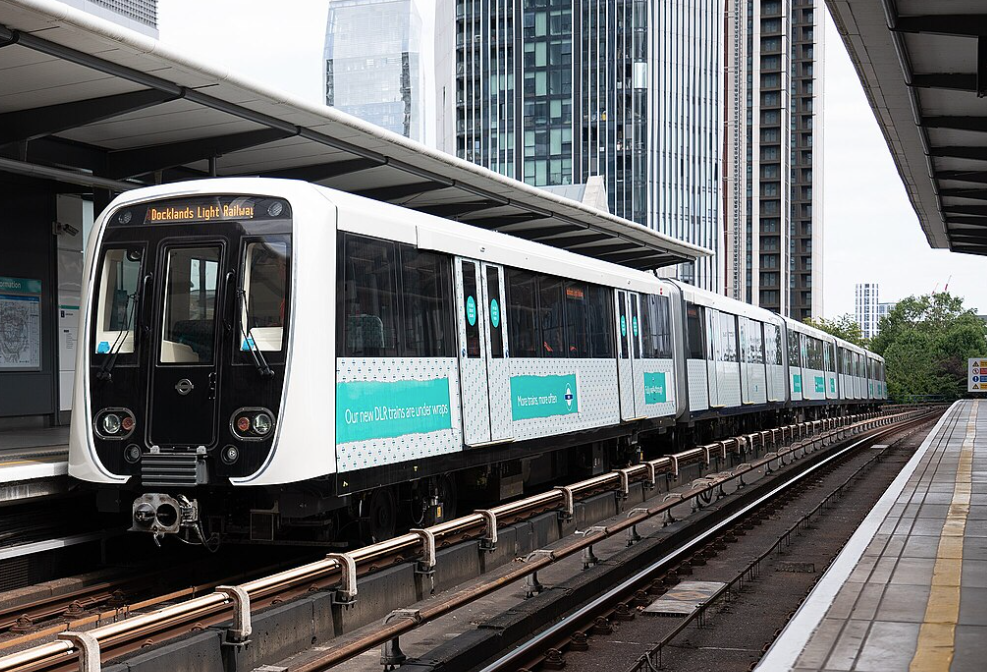
The recent withdrawal of the new B23 fleet from the Docklands Light Railway (DLR) due to issue with “braking performance” has sparked a wave of speculation. While the official investigation is ongoing and no root cause has been determined, the incident shines a spotlight on one of the most complex frontiers in railway engineering: The Integration Interface.
In a manual train, a driver feels a slide and reacts. In a Grade of Automation 3 (GoA3) system, the “driver” is a negotiation between three distinct subsystems, often built by different vendors.
This article explores the engineering architecture behind this “negotiation” and why wet rails remain the ultimate stress test for system integration.
1. The Three “Brains” of a DLR Train
To stop a driverless train at a precise point on a wet rail, three systems must communicate in milliseconds. If any link in this chain has a latency or logic mismatch, the braking curve fails.
* The Commander: VOBC (Vehicle On-Board Computer)
* Vendor: Thales (SelTrac).
* Role: The “Virtual Driver.” It knows exactly where the station is and calculates the Service Braking Curve. It sends a demand (e.g., “Decelerate at 1.0 m/s²”) to the train.
* The Messenger: TCMS (Train Control & Management System)
* Vendor: CAF.
* Role: The “Nervous System.” It receives the VOBC’s command and translates it into electrical signals for the mechanical hardware. It also manages weight compensation (load weighing).
* The Defender: WSP (Wheel Slide Protection) [is a safety critical subsystem of Brake System]
* Vendor: Brake System Supplier.
* Role: The “Reflex.” Its only job is to prevent the steel wheels from locking up and flattening. If it detects a slide, it overrides the brake command and releases pressure locally.
2. The Conflict: “Safety” vs. “Safety”
The core engineering challenge is that the VOBC and the WSP have opposing definitions of “Safety.”
* VOBC’s Goal: “Stop at the target point (Signal/Station).”
* WSP’s Goal: “Keep the wheels spinning to maintain steerability/integrity.”
The Integration Risk:
In low adhesion conditions between the train wheel and rail (wet due to rain or snow/oily rails), the WSP becomes active.
* If the WSP releases the brakes too aggressively to save the wheels, the Effective Deceleration Rate drops below what the VOBC calculated.
* The VOBC sees the train isn’t slowing down enough. It demands more brake.
* The increased pressure causes more sliding. The WSP releases more pressure.
* Result: The train effectively “floats” past the braking point.
3. Why New Trains are More Susceptible
It is common for legacy fleets (like the B07/B92) to perform differently than new fleets (B23) in the same weather.
* Mass & Inertia: The B23 is a 5-car fixed formation, likely heavier than the older units. The braking algorithm must manage significantly higher kinetic energy.
* Disc vs. Tread Braking: Older trains often use tread brakes (block on wheel), which “scrub” the wheel surface and improve adhesion. Modern trains use disc brakes, which are smoother but don’t clean the wheel tread, relying entirely on WSP and Sanders for grip.
From overall perpective, what we can say is It’s Not a “Bug,” It’s a Balancing Act. Blaming the “software” or the “hardware” in isolation is not accurate. The solution usually lies in the Interface Control Document (ICD)—tuning the specific parameters where the Signaling system accepts the WSP’s intervention without losing its position reference and to avoid this kind of issues, we need to do exhaustive Systems Integration Testing in all weather conditions (atleast by simulating low adhesion conditions) before rolling out to service.
Until the investigation concludes, the B23 incident serves as a reminder: As we move toward higher automation, the mechanical grip of steel-on-steel remains the defining constraint of our digital systems.