
Overview
Train detection is one of the most essential elements of a railway signalling system.
It answers a single safety-critical question:
Is the track section occupied or clear?
Two primary technologies are used worldwide:
- Track Circuits
- Axle Counters
Both achieve the same purpose but differ greatly in design, applications, advantages, and limitations.
Why Train Detection Is Needed
Railways require a reliable way to know:
- If a block section is occupied
- If a train has arrived or departed
- If a route is safe to set
- When to clear or hold a signal
- Whether points can move safely
- When to release interlocking routes
Without train detection:
- No automatic signalling
- No interlocking route release
- No safe train separation
In modern systems, train detection is the backbone of safety.
Track Circuits
What Is a Track Circuit?
A track circuit uses the rails themselves as part of an electrical circuit.
A low-voltage current flows through the rails.
- Clear track → current flows → block is “clear”
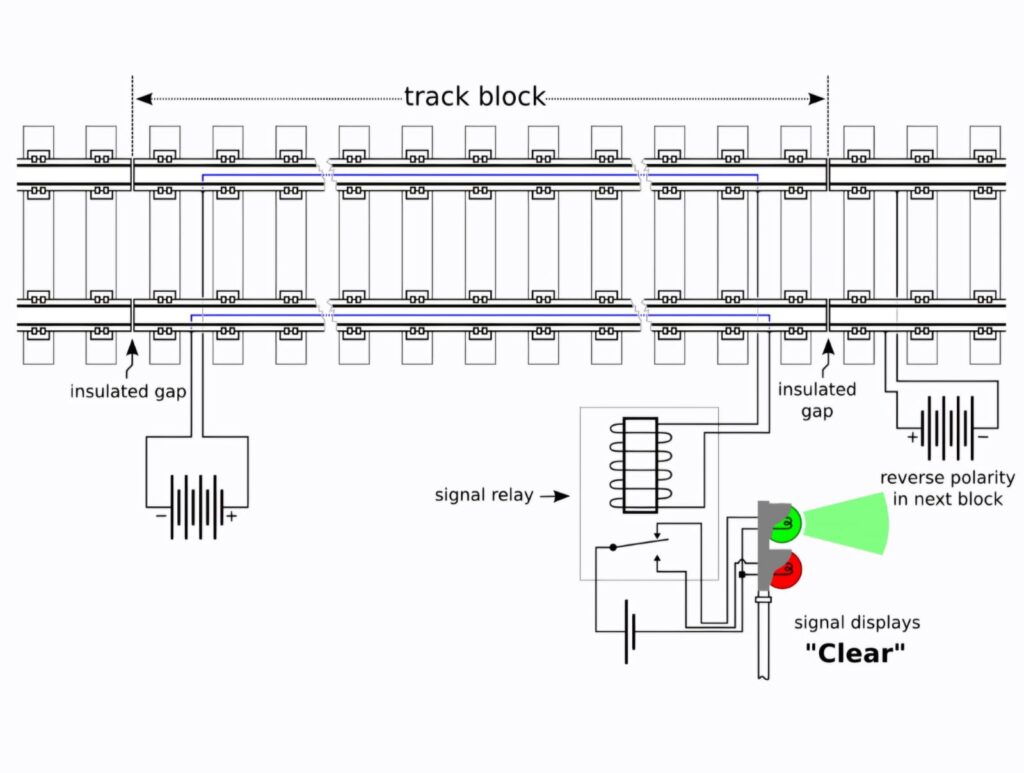
Image: “Clear track circuit” by Mangoe at en.wikipedia is licensed under CC BY-SA 3.0.
- Train present → wheels/axles short the rails → circuit drops → block is “occupied”
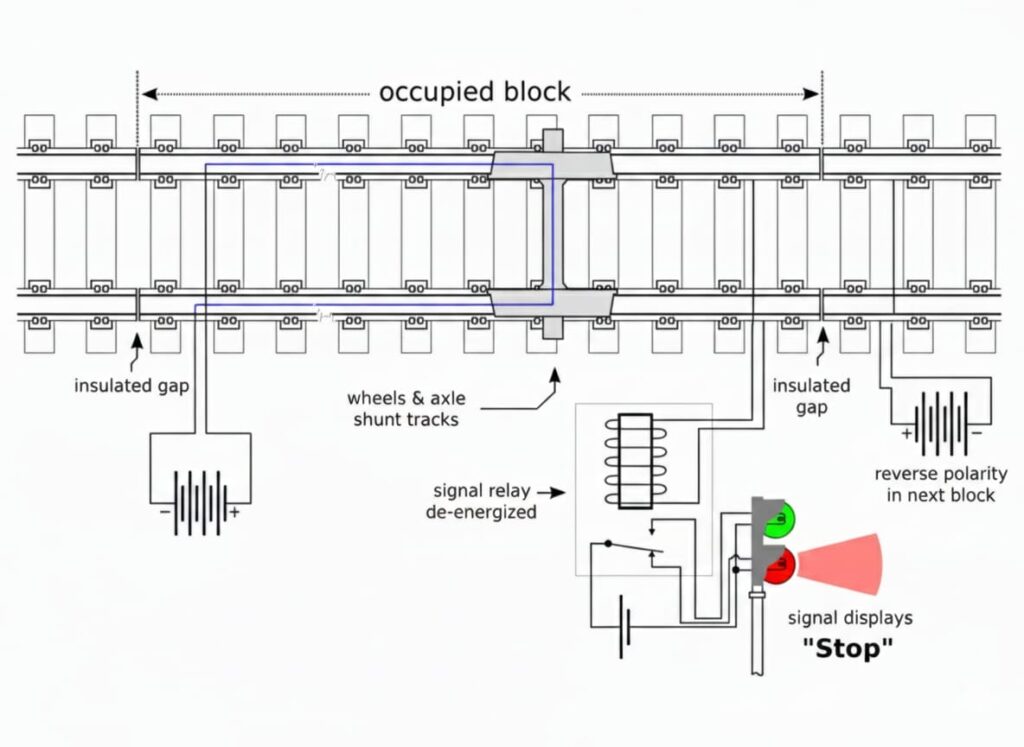
Image: “Occupied track circuit” by original File: Mangoe vector version:Completefailure is licensed under CC BY-SA 3.0.
Types of Track Circuits
Common variations include:
- DC track circuits
- AC track circuits
- Audio-frequency track circuits
- Jointless track circuits
- Coded track circuits (often used in cab signalling regions)
Where Track Circuits Are Common
- UK, Europe, India, Australia
- US commuter and freight lines (in selected regions)
- Metro networks
- High-speed corridors (often with audio-frequency types)
Advantages of Track Circuits
✔ Provide both detection and broken rail indication (in most designs)
✔ Simple concept, highly mature technology
✔ Ideal for areas requiring continuous detection
✔ Integrates well with automatic block systems
✔ Suitable for high-density operations
Limitations of Track Circuits
❌ Susceptible to poor ballast conditions
❌ Sensitive to rust, leaf fall, sand contamination
❌ Require insulated rail joints (unless jointless types used)
❌ Broken rail detection isn’t guaranteed in all designs
❌ Higher maintenance effort
Axle Counters
What Is an Axle Counter?
Axle counters detect trains by counting the number of axles entering and exiting a block section.
- Detectors (sensors) are placed at the start and end of a block
- Axles counted IN vs OUT
- If counts match → block is clear
- If the Axle In ≠ Axle Out, Effective count = Axle Out – Axle In >= 0 , counts match, meaning as many number of Axles enter the block section , the same number of Axles has exited the block section, meaning there is no single Axle left out in the entire block section → block is occupied
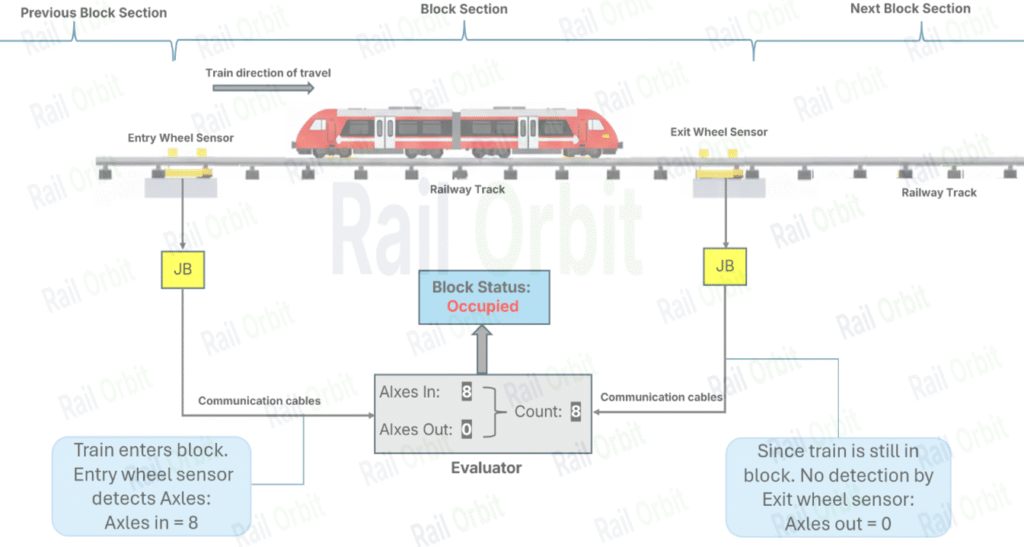
Image: Axle counter working principle , Block occupied
- If the Axle In = Axle Out, Effective count = Axle Out – Axle In = 0 , counts match, meaning as many number of Axles enter the block section , the same number of Axles has exited the block section, meaning there is no single Axle left out in the entire block section → block is clear
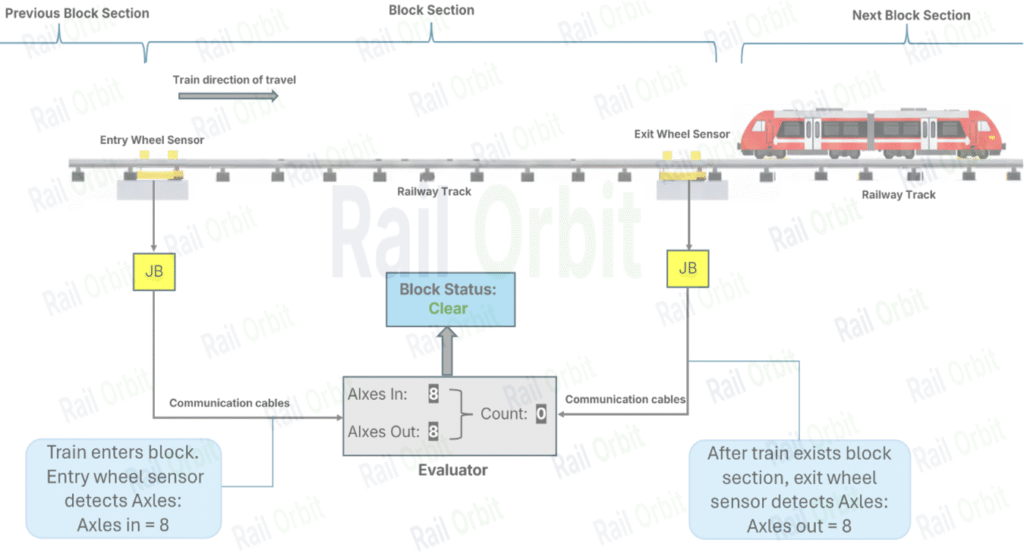
Image: Axle Counter working principle , Block Status Clear
Where Axle Counters Are Common
- Europe
- India
- Japan
- US and Canada (selected regions)
- High-rainfall or poor-ballast territories
- Tunnels, bridges, viaducts, and level crossings
Advantages of Axle Counters
✔ Not affected by:
- ballast condition
- rust
- flooding
- poor track insulation
✔ Very low maintenance
✔ No insulated joints needed
✔ Excellent for long block sections
✔ Ideal for retrofitting existing lines
✔ Works well in tunnels and bridges
Limitations of Axle Counters
❌ Won’t detect broken rails
❌ Reset procedure can affect operations
❌ Requires reliable communication channels
❌ Sensitive to electromagnetic interference (depending on design)
Track Circuits vs Axle Counters — Quick Comparison
| Feature | Track Circuits | Axle Counters |
| Detection Method | Electrical current through rails | Counting axles in/out |
| Broken Rail Detection | Yes (mostly) | No |
| Effect of Ballast Condition | Sensitive | Not affected |
| Use of Insulated Joints | Usually required | Not required |
| Best For | High-density lines, continuous detection | Long sections, tunnels, bridges |
| Maintenance | Higher | Lower |
| Failure Modes | False occupancy, voltage drop | Count errors, reset needed |
| Cost | Higher installation cost | Lower installation cost |
Where Each Technology Is Preferred
Track Circuits preferred in:
- Dense commuter networks
- Automatic block signaling areas
- Metro networks
- Regions requiring broken-rail detection
- Electrified networks with robust maintenance regimes
Axle Counters preferred in:
- Challenging ballast conditions
- Mountainous regions
- Long block sections (e.g., high-speed lines, freight corridors)
- Tunnels and viaducts
- Areas with flooding or corrosion problems
Many modern railways use a hybrid approach, combining both.
Future Trends in Train Detection
- Integration with ETCS and CBTC systems
- Move towards jointless detection
- Virtual train detection using odometry under ETCS Level 3 (research/pilots)
- Reducing reliance on track circuits in flood-prone or remote regions
Common Questions
Q: Do axle counters work during power failure?
A: Yes, with UPS or battery backup. Without power, sections remain occupied by default (fail-safe).
Q: Can axle counters and track circuits be mixed?
A: Absolutely. Many networks combine them depending on conditions.
Q: Why not switch entirely to axle counters?
A: Because axle counters do not provide broken rail detection — crucial for certain railways.
Q: Does high-speed rail use track circuits or axle counters?
A: Both are used, depending on infrastructure and signalling design.