
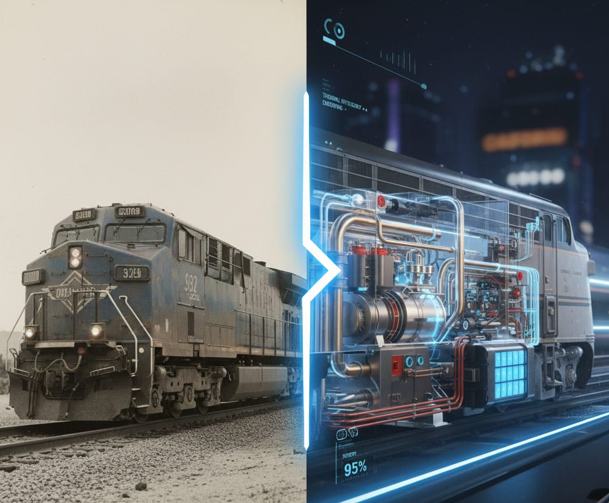
North America’s rail decarbonization debate has largely centered on two options—electrification and hydrogen fuel cells. Both require extensive new infrastructure and substantial capital expenditure.
This month, a third technology entered the conversation: a modern external-combustion, Rankine-cycle locomotive engine developed by HyOrc Corporation, with integration support from Zero-Emission Locomotive Technologies (ZELTECH).
The companies have signed a Memorandum of Understanding (MoU) with Dreamstar Lines, which is planning the Los Angeles–San Francisco overnight passenger service. The MoU explores the feasibility of hybrid locomotives powered by a HyOrc Rankine-cycle multi-fuel engine supported by onboard batteries.
This announcement is significant because it evaluates an alternative to internal combustion and fuel cells, without requiring full corridor electrification.
The Engineering Hook: What Makes Rankine Different?
The HyOrc system uses an external combustion process based on the Rankine Cycle—a thermodynamic cycle used in power plants, concentrated solar installations, and historical steam locomotives (with modernized components).
✔ How It Works
- Fuel is burned externally to heat a working fluid (steam or other vapor).
- The high-pressure vapor drives a turbine or expander.
- Waste heat can be partially recovered depending on system design.
✔ Potential Efficiency Advantage
A modern diesel engine typically achieves ~40% thermal efficiency at peak load.
Rankine-cycle systems can theoretically utilize waste heat more effectively; however, final efficiency depends on:
- boiler and heat-exchanger design
- turbine efficiency
- fluid selection
- load conditions
Note: HyOrc has not publicly released independent test results. Claims of higher efficiency should be interpreted as engineering potential, not guaranteed performance.
✔ Fuel Flexibility
External combustion systems can run on multiple fuels. HyOrc states compatibility goals that may include:
- hydrogen
- renewable fuels
- traditional fuels (depending on configuration)
When operated on hydrogen or low-carbon fuels, the system could significantly reduce local emissions.
A Repower-Focused Strategy
A key appeal of the HyOrc concept is that it can be integrated into existing locomotive platforms.
✔ North American Fleet Reality
The US and Canada together operate more than 25,000 diesel-electric locomotives, many of them 20–30+ years old.
Replacing the entire fleet with new battery-electric or hydrogen fuel cell locomotives would require:
- major infrastructure investment
- long delivery cycles
- retirement of viable locomotive bodies
✔ HyOrc–ZELTECH Proposal
The MoU outlines a long-term exploration of:
- internal repowering (replacing the prime mover inside the same carbody)
- hybridization with onboard batteries
This approach seeks to reduce capital costs by preserving existing frames and traction systems where possible.
✔ Hybrid Architecture Benefits
Coupling the Rankine-cycle engine with a battery pack may:
- smooth power demand on the external combustion system
- allow regenerative braking
- reduce fuel consumption
- support compliance with local emissions rules
The California Corridor Evaluation
The Los Angeles–San Francisco overnight service provides a high-visibility test environment.
✔ Why This Route Is Important
California is pursuing a long-term transition toward lower-emission rail operations.
The LA–SF corridor includes:
- long distances
- steep grades
- temperature variations
- air-quality-regulated urban areas
✔ Technology Fit
Current battery-electric locomotives face challenges on long, mountainous routes due to energy density limitations.
A hybrid Rankine-cycle locomotive could offer:
- higher continuous power
- flexible fuelling options
- operational range comparable to diesel
If the prototype demonstrates reliable performance and emissions reductions, it may offer a cost effective alternative to full electrification on select routes.
The HyOrc Rankine-cycle engine adds a third pathway to the US rail decarbonization discussion.
It seeks to combine:
- the efficiency potential of external combustion
- the flexibility of multi-fuel operation
- the proven operational model of hybridization
- the economic logic of repowering existing locomotives
While real-world performance will depend on testing and certification, the technology’s entrance into the market broadens the range of options available to both passenger and freight operators seeking lower-emission solutions without immediate large-scale infrastructure changes.
Sources:
Primary news release: Click Here