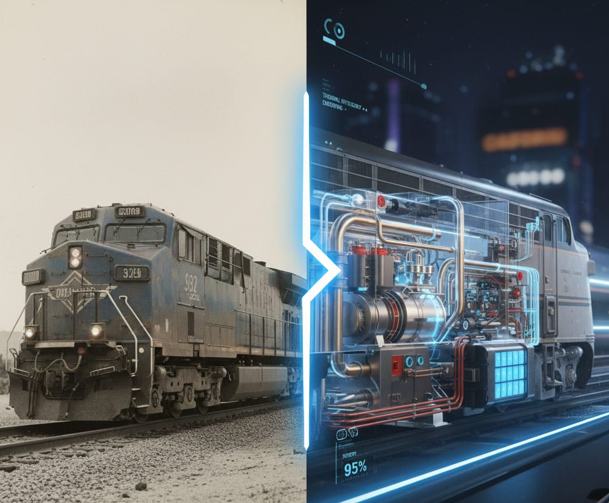
For over a century, railway electrification meant one thing: continuous overhead wires.
But the UK’s East West Rail (EWR)—connecting Oxford and Cambridge—has confirmed it will use Discontinuous Electrification supported by Battery Electric Multiple Units (BEMUs).
This represents one of the most consequential shifts in UK railway engineering in decades.
What Is Discontinuous Electrification?
Instead of wiring the entire route, EWR will install electrified “islands” at strategic sections.
Trains operate as follows:
- Under the wire: Run on 25 kV AC + fast-charge batteries
- Off the wire: Switch to battery power automatically
- At boundaries: Pantograph transitions are automated and seamless
This system leverages modern BEMUs with high-power charging capability.
Engineering Rationale: Cost, Carbon, and Civil Works
✔ Massive Civil Engineering Savings
The EWR corridor includes many low bridges and heritage structures.
Under traditional electrification, many would require multi-million pound reconstructions.
With battery operation through short gaps:
No bridge-raising required.
✔ Cleaner Visual Impact
Sections near Cambridge and environmentally sensitive zones will avoid OLE structures.
✔ Reduced Delivery Time
Electrification is often the slowest part of new railway construction.
Less wiring = faster commissioning.
Rolling Stock: The Battery Constraint
Discontinuous electrification forces a specific fleet choice:
Required Features of EWR Trains:
- Battery ranges capable of bridging multiple gaps
- Ability to accept ultra-high charging power under the wires
- High reliability for battery management
- Proven BEMU architecture (e.g., Stadler FLIRT Akku, Siemens Mireo Plus B)
Operational Risk:
If a train enters a gap with insufficient charge, it can become immobilized.
Battery State-of-Charge prediction becomes safety-critical.
East West Rail marks a decisive move toward hybrid electrification, where wires are placed only where they deliver maximum benefit.
This model offers:
- Lower cost
- Faster rollout
- Reduced carbon footprint
- Less visual intrusion
It signals the beginning of the Smart Electrification Era—where batteries and targeted OLE work together to deliver cleaner railways at lower cost.
Source : Click Here