As global competition for Copper and Cobalt intensifies, logistics has become as important as mining. The West has backed the Lobito Corridor, a modernized export route to Angola’s Atlantic coast.
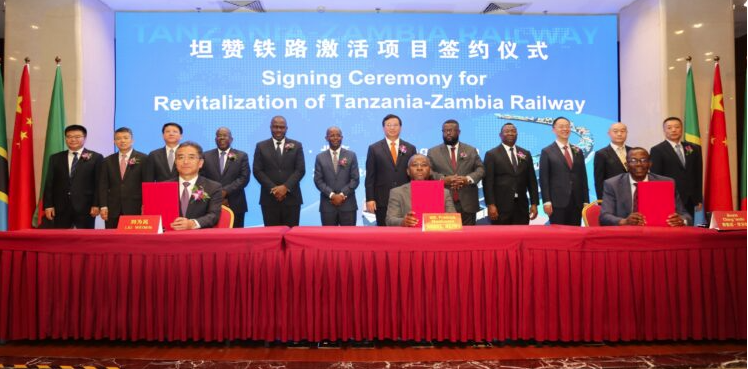
This week, China responded with a major counter-move: a $1.4 billion Public-Private Partnership to overhaul the historic TAZARA Railway, linking the African Copperbelt to Tanzania’s Indian Ocean port of Dar es Salaam.
This agreement—signed between China, Zambia, and Tanzania—is not just maintenance. It is a structural upgrade aimed at restoring TAZARA to its original purpose: a high-capacity mineral export corridor.
1. The Engineering Goal: From 100,000 → 2.4 Million Tonnes/year
Originally built in the 1970s with Chinese assistance, the 1,860 km TAZARA line has suffered from decades of underinvestment.
Today, it moves ~100,000 tonnes annually, primarily due to:
– Failing track sections
– Shortage of locomotives
– Ageing wagons
– Limited operational reliability
Under the new PPP:
🔧 Mandates for CCECC (Operator for 30 years):
Capacity Target: Increase freight throughput to 2.4 million tonnes/year (a 24× increase).
Rolling Stock: Procurement of 34 locomotives (likely heavy-haul standard-gauge-adapted Cape Gauge freight designs like the Chinese-built DF/SDD series).
Wagons: Acquisition of 760 modern freight wagons.
Track Works: Rehabilitation of ~390 km of critical sections, including bridge strengthening for higher axle loads.
2. The Geopolitics: Lobito vs. TAZARA
Africa’s Copperbelt is now served by two competing transcontinental corridors:
Westbound – Lobito Corridor (US/EU-backed)
Route: Zambia/DRC → Angola → Atlantic
Advantage: Faster sailing times to Europe/Americas
Purpose: Reduce dependence on east-bound Asian routes
Eastbound – TAZARA Corridor (China-backed)
Route: Zambia → Tanzania → Indian Ocean
Advantage: Most direct route to Asian manufacturing ecosystems
By upgrading TAZARA, China reduces its dependence on Western-aligned export infrastructure, reinforcing diversification and security of supply for critical battery minerals.
3. Technical Reality: Everything Runs on Cape Gauge
Both TAZARA and the Lobito Corridor use 1,067 mm Cape Gauge, the standard across Southern Africa.
Advantages of Shared Gauge:
Interoperability: Mines can theoretically route traffic east or west based on port conditions.
Rolling Stock Flexibility: Cape-gauge locomotives and wagons can be used on both routes.
Key Bottleneck: Port Performance.
TAZARA’s success depends heavily on improvements at the Port of Dar es Salaam, which has historically faced congestion and long dwell times.
With the new PPP, TAZARA is entering a generational upgrade cycle.
For global supply chains, the emergence of two high-capacity, competing corridors—the Lobito Corridor and TAZARA—creates redundancy, lowers logistics risk, and ultimately reduces export costs for critical green-energy minerals.